
GENERAL DENTAL TREATMENTS
Root Canal Retreatment
An option for saving the tooth in a failed root canal treatment
Provided at our clinic in Altunizade, Üsküdar (Istanbul).
IN SHORT
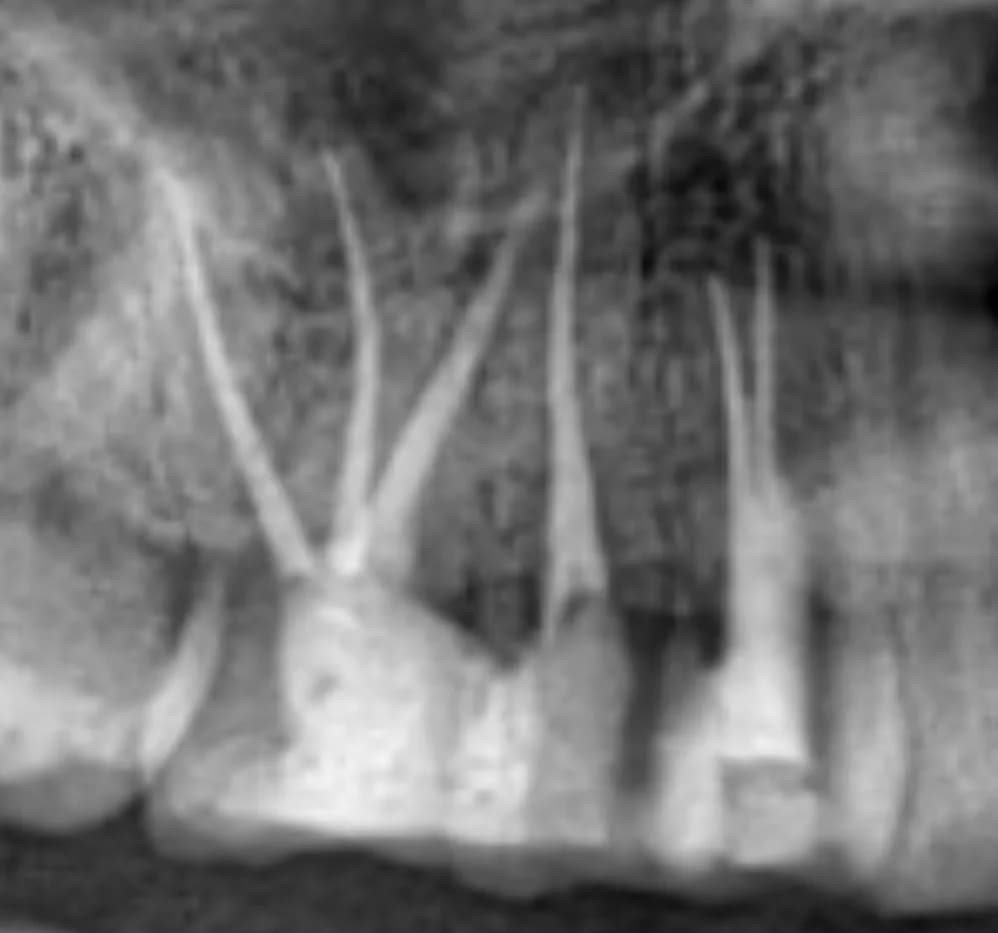
If inflammation continues or has restarted in a tooth that has previously had root canal treatment, the root canal treatment can be renewed. This is called root canal retreatment. The old canal filling is removed, the canals are cleaned again, any missed canal is found, and the canals are refilled. The aim is to keep the tooth in the mouth without extraction. If retreatment is not possible or does not give a result, apical resection or extraction is considered.
Why does root canal treatment fail?
The success rate of root canal treatment is high, but it is not a hundred per cent. Failure usually arises not from an error by the dentist but from the nature of the root canal system.
Root canals are not straight tubes. They form a network that branches, curves and connects together. It may not always be possible to clean the whole of this network.
A missed canal. A tooth may have more canals than expected. An additional canal, commonly seen in upper molars, is a typical example. Bacteria remain in an uncleaned canal.
Incomplete filling or over-filling of a canal.
Delay of the upper restoration. If the top of the tooth is not permanently sealed after root canal treatment is completed, bacteria leak from the temporary filling and the canals become re-infected. This is the most common and most preventable cause of failure.
New decay. A root-canal-treated tooth can also decay; the decay can reach the canal filling.
A crack in the tooth. A crack extending along the root becomes a constant route of entry for bacteria.
A fractured instrument inside the canal.
Which signs show that the treatment has failed?
Pain that does not go away after root canal treatment, or that comes back after a while
Sensitivity on chewing or on touching the tooth
Swelling in the gum or a small blister (a fistula). A fistula is the route by which the inflammation at the root tip drains outwards.
A bad taste in the mouth
Swelling in the face
There may be no symptoms. In most cases the failure is noticed on a routine X-ray, as a dark area (a lesion) at the root tip. This is a focus of inflammation that has formed in the bone and may not cause pain.
In addition: healing takes time. A lesion seen on an X-ray immediately after root canal treatment does not mean that the treatment has failed; the healing of the bone takes months. The assessment is made by comparing X-rays taken at set intervals.
How is retreatment done?
Assessment
The canal anatomy, the state of the existing canal filling, whether there is a missed canal and the size of the lesion at the root tip are examined with an X-ray. Whether there is a crack in the tooth is assessed.
Removal of the upper restoration
If there is a crown or a post (in-canal support) on the tooth, these need to be removed. This stage may not always be possible; if removal would damage the tooth, a different plan is considered.
Removal of the old canal filling
The filling material in the canals is cleaned out with special instruments and solutions.
Re-cleaning of the canals
A missed canal is searched for. The canals are reshaped and disinfected.
Medication
In retreatment cases it is often necessary to place an antibacterial medicament in the canals and wait a few weeks.
Refilling
The cleaned canals are filled again.
Permanent restoration
This stage should not be delayed; it is often the reason the first treatment failed.
Is retreatment harder than the first treatment?
Yes. The canals have been shaped before, they are full of filling material and there may be a restoration over them. The procedure takes longer, requires more sessions and is technically harder.
The success rate is lower than that of a first-time root canal treatment, but it is still high. In most cases where there is a chance of saving the tooth, attempting it is a suitable approach.
Risks and possible complications
The fractured instrument piece inside the canal may not be removable.
Perforation. An opening may form in the canal wall while the old filling is being removed.
Fracture of the tooth while the crown or post is being removed.
Healing still not being achieved after retreatment. In this case apical resection or extraction comes onto the agenda.
Pain and swelling lasting a few days after the procedure.
Knowing these risks is not a reason to avoid treatment, but a way to make the decision consciously. The alternative is extraction, and an extracted tooth does not come back.
If retreatment is not possible: the other options
Apical resection is the surgical removal of the root tip and the inflamed tissue around it. It is considered in the following situations: if the crown or post on the tooth cannot be removed (if removal would damage the tooth), if there is an instrument piece inside the canal that cannot be removed, or if retreatment has been carried out but no result has been obtained.
Extraction is applied in situations where the tooth cannot be saved: a vertical crack in the root, excessive substance loss, advanced bone loss. After extraction the gap can be completed with an implant or a bridge.
The decision is made according to the amount of healthy tissue remaining in the tooth, whether there is a crack, the bone support and the root anatomy. After the examination and imaging, which options are suitable and the likely outcome of each are explained one by one.
Compare the options
| Root canal retreatment | Apical resection | Extraction | |
|---|---|---|---|
| Procedure | Not surgical. Worked on from inside the canal. | A surgical procedure. The root tip is reached through the gum and removed. | A surgical procedure. |
| Tooth | Stays in the mouth. | Stays in the mouth. | Is lost. |
| When it is preferred | If the canals can be reached. | If the crown/post cannot be removed, if there is a fractured instrument, or if retreatment gave no result. | If there is a vertical crack in the root, excessive substance loss or advanced bone loss. |
| Number of sessions | Usually 2–4. | A single surgical session + check-ups. | A single session. |
| Next option | If no result is obtained, apical resection or extraction. | If no result is obtained, extraction. | Completed with an implant or bridge. |
Which option is suitable is decided together after an intraoral examination.
Frequently Asked Questions
Sensitivity lasting a few days after the procedure is an expected situation. However, if the pain lasts longer than a week, is increasing, or comes back after going away, it needs to be assessed. The state of the root tip is examined with an X-ray. A missed canal, an incompletely filled canal or a crack in the tooth may be involved.
Usually it is not. Root canals are not straight tubes but form a branching, curving network; it may not always be possible to clean the whole of this network. The most common causes are: a missed canal, bacterial leakage due to delay of the upper restoration, new decay and a crack in the tooth. Some of these are related to the patient and some to the tooth anatomy.
Usually 2–4 sessions. It is often necessary to place a medicament in the canals and wait a few weeks. It takes longer than a first-time root canal treatment.
The success rate is lower than that of a first-time root canal treatment, but it is still high. In most cases where there is a chance of saving the tooth, attempting it is a suitable approach. If no result is obtained, apical resection or extraction is considered. A hundred per cent cannot be guaranteed.
The crown needs to be removed. If the removal would damage the tooth, or if the post inside the canal cannot be removed, working from inside the canal may not be possible. In this case apical resection is considered; the root tip is reached surgically through the gum and the crown is not touched.
The dark area at the root tip is a focus of inflammation that has formed in the bone and may not cause pain. The absence of pain does not mean there is no inflammation. The inflammation can grow over time and affect the neighbouring teeth. It needs to be assessed and followed up.
Thanks to the connective tissue around the root, a natural tooth cushions the chewing force and provides a sense of position; an implant has no such tissue. As long as the root remains in the bone, the bone is preserved. If retreatment gives no result, the option of extraction is still available — but an extracted tooth does not come back. For this reason, in a tooth where there is a chance of saving it, retreatment is considered first. If there is a vertical crack in the root or advanced bone loss, extraction is the correct decision.
Related treatments
The content on this site is for information only and does not replace a clinical examination. The suitability, duration and scope of treatment are determined after a clinical assessment.
This content was prepared by Dt. Mevlüt Yazıcı.
Request an appointment.
Fill in the form to request an appointment and we'll get back to you shortly. You can also call us directly or message us on WhatsApp.
Altes Diş Kliniği
Altunizade, Üsküdar, İstanbul
- PHONE+90 533 474 43 94
- EMAIL[email protected]
- ADDRESSAlperen İş Merkezi, Valide-i Atik Mahallesi, Altunizade, Nuhkuyusu Cd D:191/B, 34664 Üsküdar/İstanbul
- WORKING HOURSWeekdays 10:00–19:00 · Saturday 10:00–16:00 · Sunday closed