
AESTHETIC DENTISTRY
Teeth Whitening
An application that lightens discolouration without removing tissue from the tooth
Provided at our clinic in Altunizade, Üsküdar (Istanbul).
IN SHORT
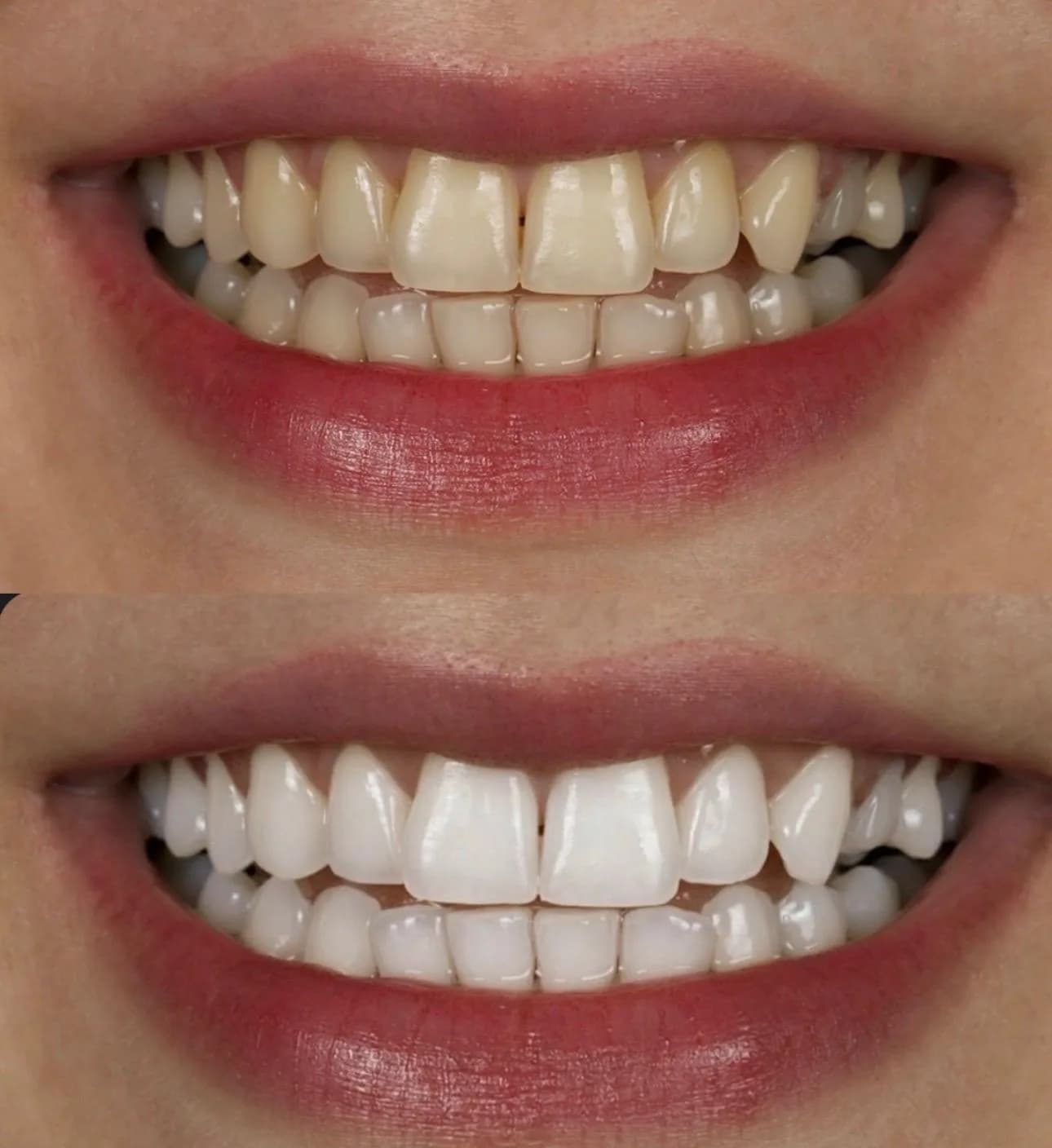
Teeth whitening is the process of lightening, with peroxide-containing gels, discolouration that has penetrated into the hard tissue of the tooth. It dissolves the discolouration; it does not remove tissue from the tooth. The result is not permanent: depending on dietary habits and smoking, the discolouration returns over time. Whitening affects only the natural tooth tissue; crowns, veneers and fillings do not whiten. Before the application, decay and gum treatments need to be completed.
Why do teeth become discoloured?
There are two types of discolouration, and distinguishing between them determines whether whitening will work.
Extrinsic discolouration. These are the deposits that tea, coffee, red wine, smoking and coloured foods leave on the tooth surface. Some of it can be removed with a scale and polish.
Intrinsic discolouration. This is the colour penetrating into the tooth tissue itself. With ageing, the dentine tissue darkens and the enamel thins. In addition, root-canal-treated teeth, teeth that have suffered trauma, the use of tetracycline-group antibiotics during the tooth development period, and fluorosis lead to intrinsic discolouration.
Whitening gels act on intrinsic discolouration; cleaning surface deposits is not the job of whitening.
How does whitening work?
Whitening gels contain hydrogen peroxide or carbamide peroxide. These substances pass into the tooth tissue and break down the large molecular structures that create the colour into smaller, colourless parts.
The important point is this: whitening does not remove substance from the tooth. It does not wear it down or thin it. It dissolves the discolouration chemically.
Who can it be applied to?
In extrinsic and age-related discolouration
In adults whose gum and dental health are sound
Who is it not suitable for, or gives a limited result for?
If there is untreated decay or gum disease. The gel seeps into the tooth through the decay and causes pain. These treatments are completed first.
In tetracycline discolouration. The result is limited and very long application may be needed; in some cases veneers or a crown are considered.
In advanced fluorosis.
In patients who have a crown, veneer or composite filling in the front region. These do not whiten.
In excessively sensitive teeth or in patients with advanced gum recession. The root surface has no enamel, and whitening markedly increases sensitivity.
In pregnant and breastfeeding women. Although there is no evidence that it causes harm, postponement is recommended because of the insufficiency of evidence.
In children and adolescents. It is not recommended because of tooth development and the size of the pulp.
Crowns and fillings do not whiten
This is the matter that the great majority of patients do not know and are disappointed by afterwards.
Whitening affects only the natural tooth tissue. Porcelain, zirconia and composite materials do not whiten.
The result: if a person who has a crown, veneer or filling on their front teeth has whitening, their natural teeth lighten and the restorations stay as they were. The colour difference between them can become more noticeable than it was before whitening.
For this reason the order matters: whitening is done first, a few weeks are allowed for the colour to settle, and then the restorations are renewed to match the new colour. If it is done in the reverse order, the restorations have to be renewed.
Charcoal, baking soda, lemon: what do they actually do?
These methods, widely shared on social media, do not whiten the tooth. They abrade it.
Substances such as activated charcoal, baking soda and salt are hard particles. When rubbed against the tooth surface, they scrape off the surface deposits. The tooth may look brighter in the first days. But these substances also abrade the enamel.
Enamel is the hardest tissue in the body; however, it is not living and does not regenerate. Abraded enamel does not come back. As the enamel thins, the yellow dentine tissue beneath it becomes more visible. In other words, in the long term these methods make the tooth look yellower. In addition, the abraded surface picks up stains more easily and sensitivity increases.
Lemon and apple cider vinegar, meanwhile, are acids. Acid dissolves the enamel directly. Applying it to the tooth surface causes damage faster than abrasive powders.
Over-the-counter products such as strips and pens may contain peroxide. Their concentration is low and their effects are limited. The main problem is that the application is not under a dentist's supervision: gel that overflows onto the gum can cause a burn, and gel that seeps in through an existing cavity can cause severe pain.
The application process
Examination
The type of discolouration is determined. Decay, gum disease and existing restorations are assessed.
Preparation
Any decay and gum treatments are completed. A scale and clean is done — without removing the surface deposit, the gel does not contact the tooth evenly.
Colour record
The initial colour is recorded with a shade guide and a photograph.
Application
An in-office method or an at-home method, or the two together, can be used.
Check-up and maintenance recommendations.
How lasting is the result?
Whitening is not a permanent procedure. The discolouration returns over time depending on dietary habits, smoking and oral care. This period varies from person to person; a definite duration cannot be guaranteed.
In the first days after the application, the tooth surface temporarily becomes more permeable. Avoiding tea, coffee, red wine, dark-coloured fruit juices and smoking during this period helps the result last longer.
Sensitivity
Hot-and-cold sensitivity after whitening is a frequent side effect. It is usually temporary and subsides within a few days.
To reduce sensitivity, products containing fluoride or potassium nitrate may be recommended before and after whitening. If sensitivity is severe, the application intervals are lengthened or the gel concentration is reduced.
Risks
Temporary hot-and-cold sensitivity. It is the most frequent side effect.
Gum irritation. This is seen if the gel overflows onto the gum; in an application under a dentist's supervision the gum is protected with a barrier.
Colour difference. Because existing restorations do not whiten, a colour mismatch may arise.
A smaller result than expected. Particularly in tetracycline and fluorosis discolouration.
If there is existing decay, the gel seeping into the tooth and severe pain. For this reason an examination is essential.
No scientific evidence has been reported that whitening carried out under a dentist's supervision and at appropriate concentrations causes permanent damage to the enamel structure.
Compare the options
| In-office | At-home | Over-the-counter products | |
|---|---|---|---|
| Where it is done | At the clinic, applied by a dentist. | At home, with a custom tray; under a dentist's supervision. | At home, unsupervised. |
| Gel concentration | High. | Low. | Very low or contains no peroxide. |
| Duration | 1–2 sessions. | Usually 1–2 weeks, a few hours a day. | Variable. |
| Gum protection | Protected with a barrier. | The custom tray limits the gel from overflowing. | None. The gel can overflow onto the gum. |
| Examination | Done first. | Done first. | Not done. Existing decay is not noticed. |
| Abrasive powder / charcoal / baking soda | — | — | Abrades the enamel. Abraded enamel does not come back. |
Which option is suitable is decided together after an intraoral examination.
Frequently Asked Questions
No scientific evidence has been reported that whitening carried out under a dentist's supervision and at appropriate concentrations causes permanent damage to the enamel structure. Whitening does not remove substance from the tooth; it dissolves the discolouration chemically. On the other hand, decay and gum treatments need to be completed before the application; if gel seeps into the tooth through an existing cavity, it can cause severe pain.
No. These substances do not whiten the tooth; they abrade it. Hard particles scrape off the surface deposits and the tooth may look brighter in the first days; but at the same time the enamel is abraded. Enamel does not regenerate; abraded enamel does not come back. As the enamel thins, the yellow dentine tissue beneath it becomes more visible, so in the long term the tooth looks yellower. Lemon and vinegar, meanwhile, are acids and dissolve the enamel directly.
No. The discolouration returns over time depending on dietary habits, smoking and oral care. The period varies from person to person and a definite duration cannot be guaranteed. Avoiding coloured foods and drinks in the first days after the application helps the result last longer.
No. Whitening affects only the natural tooth tissue. Porcelain, zirconia and composite materials do not whiten. If a person who has a crown, veneer or filling on their front teeth has whitening, their natural teeth lighten, the restorations stay as they were, and the colour difference can become noticeable. For this reason the order matters: whitening first, a few weeks of waiting, then renewing the restorations to match the new colour.
Hot-and-cold sensitivity is a frequent side effect and is usually temporary; it subsides within a few days. Products containing fluoride or potassium nitrate can reduce this sensitivity. In severe sensitivity, the application intervals are lengthened or the gel concentration is reduced.
In the in-office application, a higher-concentration gel is applied by the dentist and the result is obtained in a shorter time. In the at-home application, a lower-concentration gel is used at home with a custom tray and the duration is longer. The two can also be used together. The decision is made according to the type of discolouration, the sensitivity situation and the timeframe the patient prefers.
A result can be obtained in age-related and extrinsic discolouration. In discolouration due to tetracycline-group antibiotics or advanced fluorosis, the result is limited; in these cases veneers or a crown can be considered. The type of discolouration is determined during the examination.
Yes. In teeth that have had root canal treatment and have darkened, the whitening gel can be applied by placing it inside the tooth. This is a different method from whitening done from the outer surface and is applied to a single tooth.
Related treatments
The content on this site is for information only and does not replace a clinical examination. The suitability, duration and scope of treatment are determined after a clinical assessment.
This content was prepared by Dt. Mevlüt Yazıcı.
Request an appointment.
Fill in the form to request an appointment and we'll get back to you shortly. You can also call us directly or message us on WhatsApp.
Altes Diş Kliniği
Altunizade, Üsküdar, İstanbul
- PHONE+90 533 474 43 94
- EMAIL[email protected]
- ADDRESSAlperen İş Merkezi, Valide-i Atik Mahallesi, Altunizade, Nuhkuyusu Cd D:191/B, 34664 Üsküdar/İstanbul
- WORKING HOURSWeekdays 10:00–19:00 · Saturday 10:00–16:00 · Sunday closed