
AESTHETIC DENTISTRY
Prepless Veneer
No cutting, but it adds volume — the right case selection is decisive
Provided at our clinic in Altunizade, Üsküdar (Istanbul).
IN SHORT
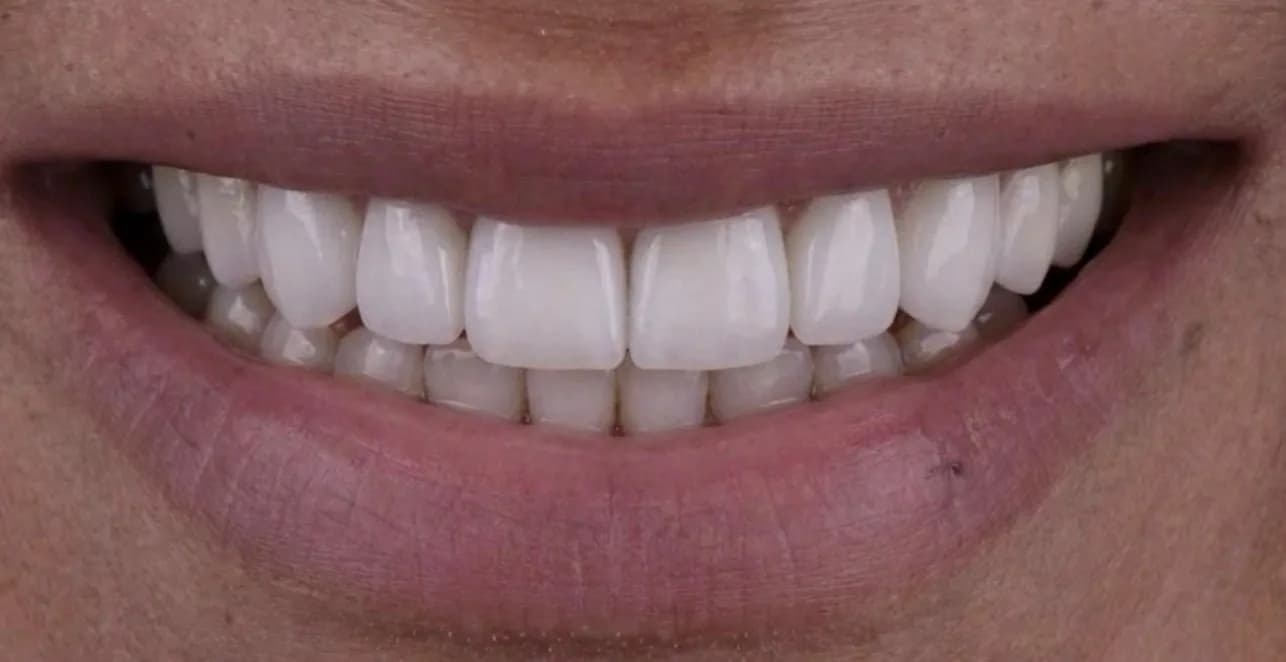
A prepless veneer is a very thin layer of porcelain bonded to the front surface of the tooth without removing any tooth substance (or removing very little). Because no cutting is done, the procedure is reversible. However, this does not mean it can be applied to every tooth: when no cutting is done, the veneer adds volume onto the tooth. For this reason it is suitable only in cases where the tooth is small, set back or narrow — that is, where there is room to add. It is not a whitening treatment.
What is a prepless veneer?
In a classic porcelain veneer, a thin layer (usually 0.3–0.7 mm) is removed from the front surface of the tooth to make room for the thickness of the veneer. This procedure is irreversible.
In a prepless veneer this removal is not done, or is very slight. The porcelain used is much thinner (usually 0.2–0.4 mm) and is bonded directly to the existing tooth surface.
The advantage is clear: the healthy tooth tissue is preserved and the procedure is reversible. If the veneers are removed, the tooth returns to its own structure.
But if no cutting is done, the veneer adds volume
This is the one mechanical fact about a prepless veneer that has to be understood, and the industry does not explain it.
When the tooth is not cut, the thickness of the veneer is added onto the existing tooth. That is, the tooth becomes thicker, larger and more protruding by the thickness of the veneer.
With a thin porcelain this addition is small. However, if the tooth is already protruding, thick or large, the result looks disproportionate and bulky. This is exactly the situation the patient describes as “my teeth looked larger than they are.”
For this reason a prepless veneer is suitable in cases where the tooth is small, set back or narrow — because there is room there to add. If the problem itself is that the tooth is small, the solution is to add volume; the fit is highest here.
Who can it be applied to?
If the teeth are smaller than their natural size (microdontia, a conical lateral incisor)
If the teeth are set back (inside relative to their neighbours)
If there is a gap between the teeth (diastema)
If there is wear or shortening at the incisal edge
If a dark space appears between the cheeks and the teeth when smiling
If there is sound enamel tissue. Porcelain bonds to enamel; the bond to dentine is much weaker.
Who is it NOT suitable for?
This section is the most important part of the page.
If the teeth already protrude. Adding volume increases the protrusion.
If the teeth are thick or large. The result looks disproportionate.
In crowded teeth. To camouflage a protruding tooth its neighbours have to be thickened; this enlarges the whole row of teeth. In these cases orthodontics is needed first.
In persistent and intense discolouration. Very thin porcelain is not enough to cover a dark background; the colour can show through from beneath the veneer. In these cases a prepped veneer or a crown is considered.
If the enamel tissue is insufficient. Porcelain bonds to enamel; if the enamel is worn or absent, the bond remains weak.
In a severe teeth-clenching habit. The porcelain is very thin. The use of a night guard is needed.
In active decay or gum disease.
Mock-up: where the decision is made
In a prepless veneer the mock-up (temporary trial) stage is especially important, because how the added volume will look can only be understood when it is tried in the mouth.
The planned result is applied over the teeth with a temporary material. At this stage the patient sees how much the teeth will thicken, how the closure of the lips will be affected and how the smile line will change.
No permanent procedure is begun until the mock-up is approved. Even though a prepless veneer is reversible, removing the veneers is also a procedure; it is more correct to prevent disappointment from the outset.
The application process
Examination
Tooth sizes, position, the bite, enamel thickness and gum health are assessed.
Suitability decision
Whether the tooth is suitable for adding volume is determined. If it is not suitable, this is stated clearly and a prepped veneer or other options are explained.
Digital planning and mock-up
The result is tried in the mouth.
Impression
Because no cutting is done, a temporary veneer is usually not needed.
Try-in
The prepared veneers are tried in the mouth.
Bonding
The enamel surface is prepared and the veneers are bonded. This bond forms almost all of the durability of the veneer; isolation is critical.
Risks
Fracture. Prepless veneers are thinner than classic veneers.
Loss (separation of the bond). The risk increases if the enamel is insufficient.
Disproportionate appearance. This arises when applied to an unsuitable tooth; the mock-up stage is there to prevent it.
Gum irritation. If the edge of the veneer overhangs onto the gum, inflammation can develop.
Discolouration at the bonding line.
A temporary change in speech. It can last a few days because of the added volume.
Prepless and prepped veneers
Both methods bond a thin porcelain to the front surface of the tooth. The difference is whether the tooth is cut and the effect of this on the volume of the tooth. The table below compares the two.
Compare the options
| Prepless veneer | Prepped (classic) porcelain veneer | |
|---|---|---|
| Tooth cutting | None or very little. | Yes (0.3–0.7 mm). |
| Reversibility | Possible. If removed, the tooth returns to its own structure. | Not possible. |
| Porcelain thickness | Very thin (0.2–0.4 mm). | Thicker. |
| Effect on the tooth | ADDS VOLUME. The tooth becomes thicker. | The volume does not change, as room is made by the amount removed. |
| Suitable tooth | Small, set-back or narrow teeth. | Normal or protruding teeth. |
| Covering intense discolouration | Limited. The colour can show through. | Covers better. |
| Temporary veneer | Usually not needed. | Needed. |
Which option is suitable is decided together after an intraoral examination.
Frequently Asked Questions
No. When no cutting is done, the veneer adds volume onto the tooth; that is, the tooth becomes thicker and more protruding. For this reason it is suitable only in cases where the tooth is small, set back or narrow. If the teeth already protrude or are thick, the result looks disproportionate. Suitability is determined at the clinical examination and the mock-up stage.
Because no tooth substance is removed, when the veneers are removed the tooth returns to its own structure. This is not possible with a prepped veneer. However, removal is also a procedure and requires work on the enamel surface; for this reason the decision should again be made carefully at the mock-up stage.
In prepless veneers the porcelain is very thin and may not be enough to cover a dark background; the colour can show through from beneath the veneer. In intense discolouration a prepped veneer or a crown gives a more predictable result. In mild discolouration teeth whitening can be considered first.
To camouflage a protruding tooth the neighbouring teeth have to be thickened; this enlarges the whole row of teeth and leads to a disproportionate appearance. In crowding, orthodontics (clear aligners or braces) is recommended first, then an aesthetic application if needed.
Prepless veneers are thinner than classic veneers. Biting hard objects, biting nails or clenching the teeth can lead to fracture. In patients with a teeth-clenching habit the use of a night guard is recommended.
The added thickness depends on how thin the porcelain used is and is usually limited. However, the result varies according to the existing thickness of the tooth. The only way to see this in advance is the mock-up stage: the planned result is tried temporarily in the mouth and assessed before moving on to the permanent procedure.
Related treatments
The content on this site is for information only and does not replace a clinical examination. The suitability, duration and scope of treatment are determined after a clinical assessment.
This content was prepared by Dt. Mevlüt Yazıcı.
Request an appointment.
Fill in the form to request an appointment and we'll get back to you shortly. You can also call us directly or message us on WhatsApp.
Altes Diş Kliniği
Altunizade, Üsküdar, İstanbul
- PHONE+90 533 474 43 94
- EMAIL[email protected]
- ADDRESSAlperen İş Merkezi, Valide-i Atik Mahallesi, Altunizade, Nuhkuyusu Cd D:191/B, 34664 Üsküdar/İstanbul
- WORKING HOURSWeekdays 10:00–19:00 · Saturday 10:00–16:00 · Sunday closed