
ORTHODONTICS
Clear Aligner Treatment
Gradual alignment with a series of clear aligners
Provided at our clinic in Altunizade, Üsküdar (Istanbul).
IN SHORT
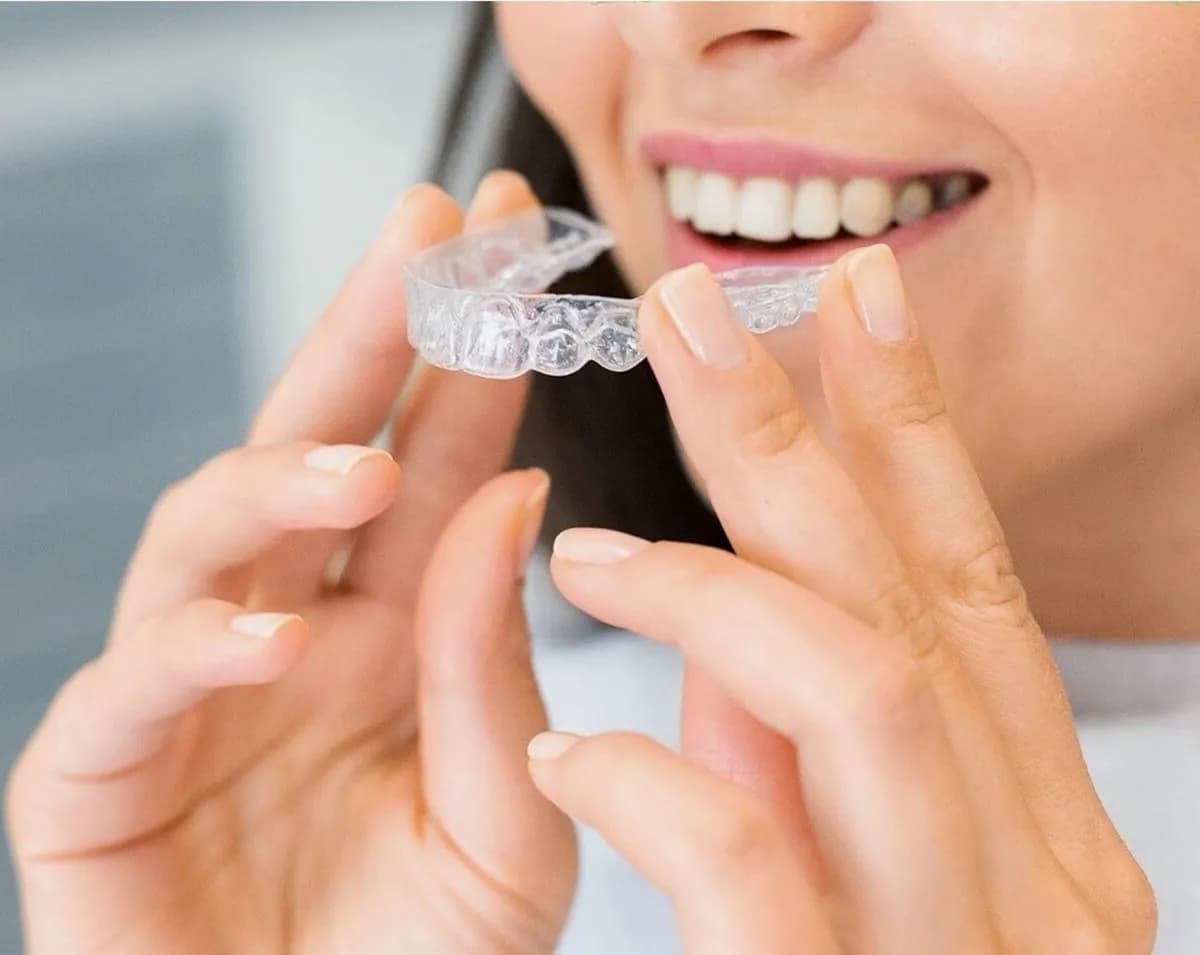
In clear aligner treatment, a series of successive clear aligners is used to move the teeth into the planned position. Each aligner moves the teeth a small amount and is replaced with a new one roughly every 1–2 weeks. The aligners are removable; however, they must be worn 20–22 hours a day. Not adhering to this time prolongs the treatment and directly affects the result. Effective results can be obtained in mild and moderate crowding; in advanced cases fixed braces treatment may be needed.
What is clear aligner treatment?
Clear aligner treatment begins with a digital scan of the teeth and the planning of the target position in a computer environment. The movement between the starting position and the target position is divided into small steps. A separate aligner is produced for each step.
The patient uses the aligners in sequence. Each aligner applies a light force to the teeth and moves them into the position that the next aligner will accept. The aligners are usually changed every 1–2 weeks.
Two details patients are not aware of
Clear aligner treatment is usually described as "completely invisible, nothing is bonded on". In most cases this is not true. Two details need to be known before treatment begins.
1. Attachments. The aligner cannot grip a flat tooth surface. For certain movements to occur, small tooth-coloured composite bumps are bonded onto the teeth. These are the points where the aligner grips and applies force. They are removed at the end of treatment and the tooth surface is polished. Although the attachments are tooth-coloured, they can be noticed at close range.
2. Interproximal reduction (stripping / IPR). If there is not enough space for the teeth to fit, a very thin layer (usually 0.2–0.5 mm) can be reduced from between the neighbouring teeth to gain room. This procedure is irreversible. It is not needed in every case; if it is needed, it is stated in the treatment plan.
Explaining these two details in advance prevents the disappointment experienced in the middle of treatment.
Patient compliance: the single factor that determines treatment
The aligners are removable. This is both the greatest convenience and the greatest risk of clear aligner treatment.
The aligners must be worn 20–22 hours a day. They are removed only while eating and brushing the teeth. Drinks other than water should not be consumed while the aligner is in; hot drinks can deform the aligner and coloured drinks cause staining.
When the daily wear time is not adhered to, the teeth do not reach the planned position. The next aligner does not seat; treatment stops. In this case, either the previous aligner is returned to, or a new scan is taken and the aligners are re-produced (refinement). In both cases the duration is prolonged.
This risk does not exist with fixed braces treatment; the brackets cannot be removed. If it is foreseen that patient compliance cannot be ensured — particularly in child and adolescent patients — the fixed system gives a more reliable result.
In which cases can it be applied?
Mild and moderate crowding
Closing spaces between teeth (diastema)
Mild bite irregularities
Patients who have had orthodontic treatment before and whose teeth have moved back because they did not use retention (relapse cases)
Adult patients who do not accept the appearance of brackets and who can adhere to the daily wear time
In which cases is it not suitable?
Advanced crowding.
Cases requiring tooth extraction. Closing the extraction space requires bodily movement of the root; this movement is limited with clear aligners.
Severe bite disorders (open bite, severe deep bite, crossbite).
Bringing an impacted tooth into the mouth.
Severe skeletal disorders. It may need to be planned together with orthognathic surgery.
Cases where it is foreseen that the daily wear time cannot be adhered to.
Untreated gum disease or active decay. These are addressed first.
The limit of clear aligner treatment arises not from the aligner itself but from the type of force it can apply. This is not a limit that can be overcome by changing brand.
What is Invisalign? Is it different from clear aligners?
Invisalign is the commercial name of one of the systems that apply the clear-aligner method. The same method is also applied with other manufacturers' systems.
The essence of the treatment — digital planning, a series of clear aligners and moving the teeth gradually — is the same regardless of the system. The differences between systems relate to the planning software and the aligner material.
The treatment decision is made not according to the brand of the system, but according to whether the case is suitable for clear aligner treatment. In a case with advanced crowding or a severe bite disorder, clear aligners may not be sufficient whichever system is used.
The treatment process step by step
Examination and records
An intraoral examination, panoramic and cephalometric X-rays, photographs and a digital scan.
Suitability assessment
Whether the case can be treated with clear aligners is determined. If it is not suitable, this is clearly stated.
Digital planning
The target position of the teeth and the intermediate steps are planned. Whether attachments and interproximal reduction are needed is determined at this stage.
Production and delivery of the aligners.
Bonding the attachments
Applied in cases where it is needed. It is painless.
Use of the aligners
Each aligner is used for 1–2 weeks; worn 20–22 hours a day.
Check-ups
Usually every 6–8 weeks. Whether the planned movement has occurred is checked.
Retention (retainer)
Treatment does not end here; the retention stage is mandatory.
How long does treatment take?
Depending on the degree of crowding and patient compliance, it usually varies between 6–24 months. The exact duration is determined after the digital planning.
The stated duration is calculated on the assumption that the aligners are worn 20–22 hours a day. When this time is not adhered to, the planned duration becomes invalid.
Retention (retainer)
When clear aligner treatment is over, the teeth are in the planned position, but they do not stay there permanently. Until the bone and connective tissue adapt to the new position, there is a tendency to move back.
For this reason, a retention appliance is used at the end of treatment: a fixed wire bonded to the back surface of the teeth and/or a clear plate worn at night. Retention is part of the treatment; it is not an optional extra.
Risks and possible complications
The planned movement not occurring. A new scan and the production of additional aligners (refinement) may be needed; the duration is prolonged.
Attachments coming off. They need to be re-bonded.
Pressure and sensitivity lasting a few days when switching to a new aligner.
Temporary change in speech. It usually passes within a few days.
Loss or deformation of the aligner. It needs to be re-produced.
Risk of decay if sugary or acidic drinks are consumed while the aligner is in. The liquid is trapped beneath the aligner.
In cases where interproximal reduction (IPR) is carried out, the procedure is irreversible.
Relapse. Seen when retention is not used.
Compare the options
| Clear aligners | Braces (metal brackets) | |
|---|---|---|
| Visibility | Not prominent. Attachments can be noticed at close range. | Prominent. |
| Removability | Removable. | Cannot be removed. |
| Patient compliance | Decisive. 20–22 hours a day is required. | Not required. The system is continuously in the mouth. |
| Applicable cases | Mild and moderate. | Widest scope, including advanced cases. |
| Bite disorders | Limited. | Wide-ranging. |
| Cases with tooth extraction | Limited. | Applicable. |
| Bringing an impacted tooth in | Not applicable. | Applicable. |
| Check-up frequency | Every 6–8 weeks. | Every 4–6 weeks. |
| Oral care | Brushed with the aligner removed. | The area around the brackets is hard to clean; risk of decalcification. |
| Eating and drinking | The aligner is removed; no restriction. | There is a restriction on hard and sticky foods. |
| Treatment duration | 6–24 months (depending on compliance). | 18–30 months. |
Which option is suitable is decided together after an intraoral examination.
Frequently Asked Questions
No. Effective results can be obtained in mild and moderate crowding. In situations such as advanced crowding, cases requiring tooth extraction, severe bite disorders and bringing an impacted tooth into the mouth, fixed braces treatment is needed. This limit arises from the type of force the aligner can apply and cannot be overcome by changing brand.
The aligners must be worn 20–22 hours a day. They are removed only while eating and brushing the teeth. Not adhering to this time prolongs the treatment; the next aligner may not seat and the aligners may need to be re-produced.
In most cases, yes. Small tooth-coloured composite bumps called attachments are bonded to the teeth. The aligner grips these to apply force. They are removed at the end of treatment and the tooth surface is polished. Although they are tooth-coloured, they can be noticed at close range.
Invisalign is the commercial name of one of the systems that apply the clear-aligner method. The same method is also applied with other manufacturers' systems. The essence of the treatment is the same; the differences relate to the planning software and the aligner material. The treatment decision is made not on the basis of brand, but on the suitability of the case.
No. The aligners are removed while eating. Drinks other than water should also not be consumed while the aligner is in; hot drinks can deform the aligner, and sugary and acidic drinks become trapped beneath the aligner and increase the risk of decay.
It usually varies between 6–24 months. The duration depends on the degree of crowding and on patient compliance. The stated duration is calculated on the assumption that the aligners are worn 20–22 hours a day.
You should call the clinic. Depending on the situation, it may be necessary to return to the previous aligner or to re-produce the lost aligner. Every day spent without wearing the aligner causes the teeth to move back.
If a retainer is not used, there is a tendency to move back, and this tendency can continue for years. At the end of treatment, a fixed retention wire and/or a clear plate worn at night is used. Retention is part of the treatment.
Related treatments
The content on this site is for information only and does not replace a clinical examination. The suitability, duration and scope of treatment are determined after a clinical assessment.
This content was prepared by Dt. Mevlüt Yazıcı.
Request an appointment.
Fill in the form to request an appointment and we'll get back to you shortly. You can also call us directly or message us on WhatsApp.
Altes Diş Kliniği
Altunizade, Üsküdar, İstanbul
- PHONE+90 533 474 43 94
- EMAIL[email protected]
- ADDRESSAlperen İş Merkezi, Valide-i Atik Mahallesi, Altunizade, Nuhkuyusu Cd D:191/B, 34664 Üsküdar/İstanbul
- WORKING HOURSWeekdays 10:00–19:00 · Saturday 10:00–16:00 · Sunday closed